
This website uses cookies to ensure you get the best experience.
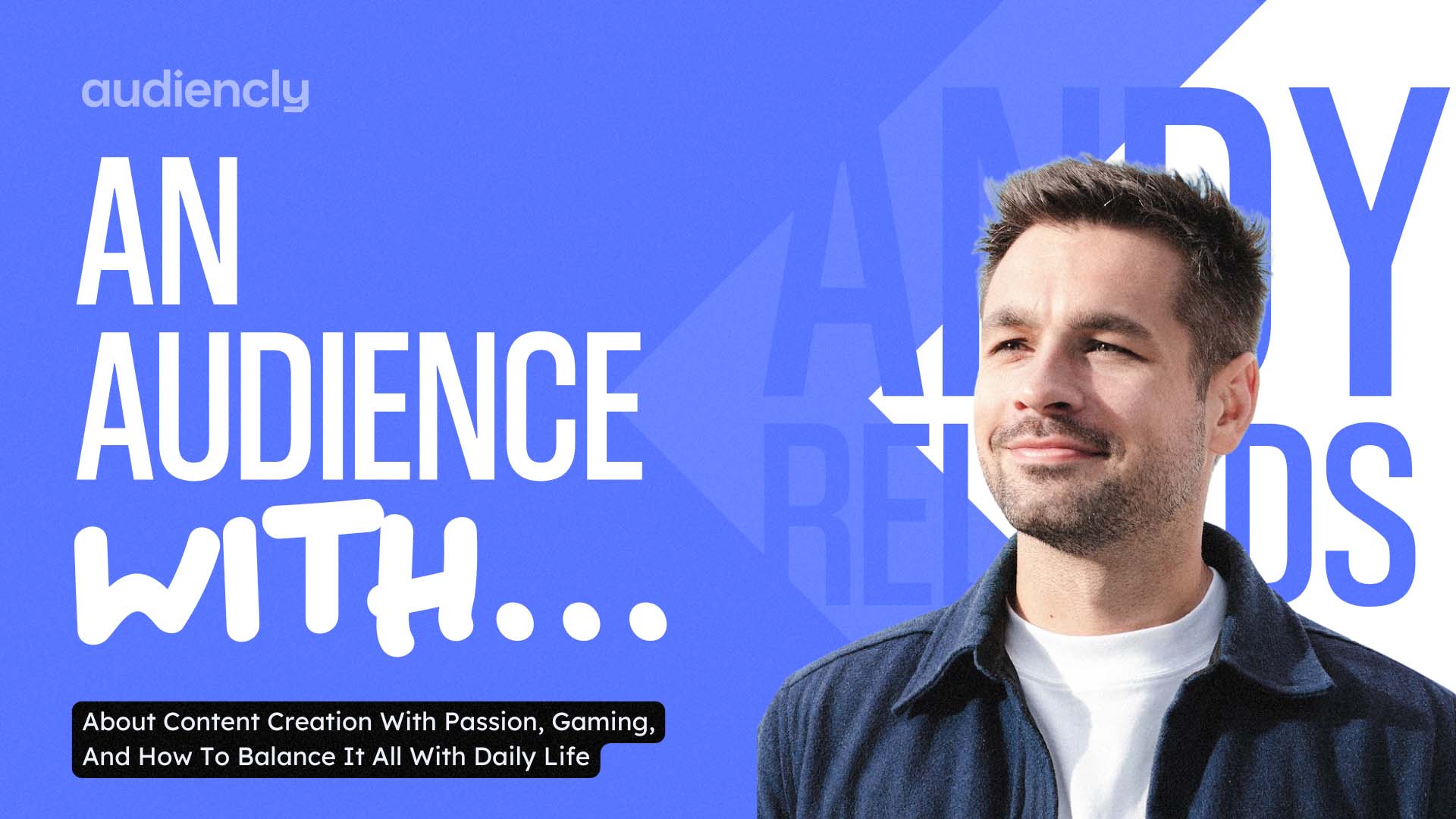
Welcome to An Audience with… where we engage with content creators, both big and small, to discuss their careers, influencer marketing, and what makes or breaks good content.
With this series, we aim to showcase the diverse journeys and platforms of the talents we work with, revealing how each is shaping their unique path in the influencer landscape. Whether you’re just starting out as a content creator yourself or if you’re a brand looking for the next talent to partner with, An Audience with… introduces you to the talents behind the screens.
In this edition, we feature AndyReloads, one of the few creators trusted by major companies such as Ubisoft, Sony, Warner Bros, and Disney. He offers his community straightforward guides and reviews for the latest big franchise games, including Assassin's Creed and Hogwarts Legacy.
I run the YouTube channel AndyReloads, where I focus on open-world, RPG and big single-player games, things like Assassin’s Creed, Star Wars, Hogwarts Legacy and similar titles.
I started the channel during COVID for two reasons.
Firstly, I’ve always loved pulling games apart and figuring out how they really work. Exploring builds, gameplay systems, hidden mechanics, and also finding secret easter eggs the devs have hidden in their games.
So for ages, I couldn’t find the exact kind of practical, no-nonsense guides, reviews, or general commentary about these games that I wanted myself.
Secondly, up until COVID, I was stuck in a more “traditional” career path and wanted a creative outlet that I actually cared about.
This is when I thought I’d start recording dodgy videos in my spare room, which has slowly turned into a proper job where I’ve met some awesome people and travelled all over the world.
These are awesome experiences, but for me, the focus still remains the same in any video I make, and that’s to respect people’s time, be honest with my opinions and try to make each video feel like it was worth the click.
If a viewer can come away and feel like they’ve got something from it, then the video was worth the effort.
Honestly, it probably would’ve been easier to lean into FPS games like Call of Duty, Fortnite or whatever the big mainstream title is that month, as there’s a constant stream of interest there and a very clear niche.
I do enjoy those games, but I grew up on single-player stuff. They were my way to switch off after work, and I’ve been playing that style of game (as well as watching my dad play them) since I was a kid.
So when I started making videos for Assassin’s Creed, Star Wars, Hogwarts Legacy, or any other big franchise, I didn’t have to sit down and “learn” the lore, mechanics, or systems from scratch; that foundation was already there, if you know what I mean?
The real challenge was figuring out how to actually make good videos about them… which I’m still working on to this day, lol.
That said, you’re right, it is a tougher space, because it’s not as instantly popular as some other gaming niches, but that’s partly why I like it.
Rather than doing “variety” in the sense of playing absolutely everything, I see it as specialising in a specific type of game: open-world, RPG-leaning experiences with loads to learn, optimise and explore.
My content is less pure “hype coverage” and more like a “systems tour guide” for that specific game.
So for example:
In my opinion, that really matters, because these types of games can be horrifically long, so if I can show you something that saves you 15 hours with a smart unlock or specific route you should take before you even start, you’re going to appreciate that, as I know I did when I watched something similar pre-Youtube.
Because of that, I’d rather put out one strong, practical review or guide that genuinely helps people than ten surface-level videos chasing trends.
Over time, I think that’s what’s built trust with the people who watch my channel, they know that when a new single-player or open-world game drops, they can come to my videos for a proper deep-dive, without all the bloated fluff you’d pick up in the basic tutorial these games provide when you log in.
I’ve always found the words “career” and “influencer” a bit bizarre, because I definitely am not an influencer, and I don't really see this as a career, perhaps even if it technically is.
I say that because when I hear “influencer”, I think of someone like Jake Paul, not some dude in his bedroom talking about game mechanics in a Harry Potter game, lol.
That said, I don’t think I’ve ever worked as hard at anything as I have on YouTube. For the first couple of years, if you divided the ad revenue and odd sponsorship by the hours I was putting in, I’d have been much better off stacking shelves in a supermarket - genuinely no exaggeration here.
So if you’re coming into this purely to make bank, and you’re not already experienced or have an outrageous natural talent for making content, it’s probably going to be a long road before it’s truly “sustainable.”
The reason I say that is I’ve come to learn that there are so many variables you’ll never be able to control when it comes to content creation: algorithm changes, game cycles, ad rates, brand budgets, people's viewing habits and interests, etc.
So I think sustainability becomes more about being comfortable with day-to-day uncertainty than hitting a specific income target every month. The numbers will move around a crazy amount, and then the process becomes learning to be ok with that.
When I started, my goals were simple: make videos, get better at making videos, and talk about a franchise I loved with people who felt the same way.
I think that mindset is way more helpful than obsessing over a monthly cash goal, because it’s the passion for the process and the source material that actually gets you back to your laptop or PC after a long day at your “real life” job, to then be motivated to spend tens of hours on a single upload.
If you quit your job before you’ve even proven you enjoy the process, you put insane pressure on yourself to instantly replace that wage.
That pressure 100% bleeds into the content, and you can see it all over YouTube right now.
You’ve probably already watched a video this week where it’s obvious the channel in question has prioritised clickbait, padded it out to 15 minutes longer than it should be just to bump watch time and squeeze in more ads, or has generally made choices that aren’t viewer-centric at all.
For me, that’s not how you build a real community or anything remotely stable.
Off the top of my head, it took around seven months of consistent uploading to hit my first 100 subscribers, and about two years after that, the channel had passed 100k.
If you just keep doing that over a long enough period, the right audience will find you, and in my experience, that’s when the whole “career” or “influencer” label, or whatever you want to call it, is far more likely to happen as a by-product rather than the main goal.
So my short answer would be: pick something you genuinely like enough to talk about for years, make videos for people just like you, and focus on improving each upload by 1%.
I think there’s a big misconception that these opportunities just suddenly appear or come around quickly, when that’s really not the case at all.
For the first couple of years, I sent what felt like hundreds of emails and DMs to studios, community devs, PR managers, anyone you could think of, basically, in an attempt to try and get more involved with the games I was already covering and loved.
You probably know the answer, but I heard nothing back, time and time again lol.
Truthfully, that really sucked for a long time. You start to think, “Am I doing something wrong here? What's the deal?” This is, of course, not the case.
That said, when that failed, I turned to multiple other creators in my niche and asked how they’d got in touch with certain reps, which was made even more challenging when each one gave me a non-answer in return.
Naive at the time, I now know a lot of them didn’t want to risk giving someone new similar access, as that might impact their own viewership.
It was, and still is, a weird clique dynamic in this content creation space, and it’s one of the reasons I promised myself that if I was ever more involved on that side of things, I’d actively try to help people and put them in touch with the right contacts, because I really struggled to get a foot in the door initially.
If I could go back in time, I’d tell myself that the most important thing is to just keep doing what you’re doing: improve each upload and continue to actually engage with the people who take the time to share their thoughts with you, just like you do with them in your videos.
Over time, that’s how you get noticed. And when that happens, being professional, polite and responsive is the way to go.
If a publisher reaches out, it’s because they already like what you’re doing. That doesn’t mean you suddenly switch up your content to chase what you think they want.
If your core goal is simply to get the big outfits on side, rather than to serve your audience and make videos you actually believe in, it’s never going to feel right, and it probably won’t last.
For me, the short answer is that the connection changes how I can make content, not what I say in it.
When I get early access to something like a new Assassin’s Creed title, it mainly affects the logistics: I’ve got more time to properly test builds, explore different playstyles, find weird interactions and plan videos so they’re ready close to launch.
It means I can hit the ground running with guides, breakdowns and “things I wish I knew before I started” type videos, rather than scrambling after release. That’s the upside.
Where I draw a really hard line is around the actual opinions.
My audience comes first, every time.
If I start softening my takes or shaping videos around what I think a publisher wants to hear, people aren’t stupid and will clock that immediately, then the whole thing collapses.
For me, it’s about keeping my integrity, being fair in both criticism and praise, and actually explaining why I feel that way.
I kind of think of it like this:
If I'm sitting on the sofa after work, watching my own video, what would I actually want from a review or from someone who has access to the dev team?
I’d want fair takes, honest questions and real conversations, good and bad, that doesn’t shy away from the less appealing parts of the game, but also highlight what works well and what there is to look forward to.
Screaming into the online void that a game “sucks” purely for ragebait just isn’t fun for me, even if that kind of sensationalism does well on YouTube right now and would probably make me more money in ad revenue.
So I’m more than happy to sign NDAs, respect embargoes and avoid showing spoilers or specific footage at launch as that’s just part of protecting the player experience, but I’m not interested in turning the channel into a PR feed, nor do I think the studios or partners you work with want that either to be honest.
If something’s great, I’ll say so. If something’s rough, I’ll say that too, but I try to do it in a fair, specific and constructive way.
I’m also upfront about the relationship. If a video is sponsored, I mention it in the first 10 seconds of the video. If I had early access or a review code, I’ll mention that as well.
To me, being transparent with people is non-negotiable.
If you go to great lengths to hide how something came about, whether that’s early access, a new sponsorship or anything else partner-related, people will notice anyway, so there’s really no point in anxiously trying to mask this.
In fact, being straight with people and directly upfront actually makes it easier to balance everything, because the audience understands the context and then it's totally up to them whether they trust my judgement or watch the video, it’s their call.
Behind the scenes, I’ll often share more detailed feedback directly with the teams as well, stuff that might be too niche or technical for a public video.
One of the coolest things about being a “trusted creator”,or whatever you want to call it, is that you can take the concerns and thoughts people share with you straight to the developers, instead of them going through six different internal departments and those messages getting completely sanitised.
That’s how relationships with studios and partners should work in my opinion: a proper feedback loop, not just a PR mouthpiece cash grab for a campaign they’re running in Q4.
I think the biggest misconception is that making gaming videos online means you sit around playing games all day for easy money.
I know this first-hand, because that’s exactly what I thought it was before I started, and I honestly wish that was the case, lol.
In reality, it’s long hours for a really unpredictable payoff, both in terms of how people receive the video and what it earns.
How well something does can depend on a bunch of stuff completely outside your control, such as how popular that game still is, what else is launching that week (or isn’t), the time of year, and about a hundred other factors I won’t list here.
You’ve also got to factor in that the gaming niche in general doesn’t exactly have the highest RPMs (what you earn per 1,000 views), so even when something performs “well”, nine times out of ten it’s not life-changing money.
To give you an example, 1,000 views in the gaming niche might give you under $1, whereas a finance video can easily hit well over $10–$15 per 1,000 views. That’s just the reality of the landscape.
In terms of time, I’d say maybe 5% of it is actually playing the game and 95% is everything else, that being; recording, capturing b-roll, script writing and re-writing, voiceover, editing, thumbnails, metadata, community replies, chasing emails, optimising the video in YouTube’s backend, dealing with sponsorship admin… the list goes on.
The fun bit (playing) is usually the smallest slice of the whole process.
Another thing people don’t see is that most of us are basically making it up as we go along.
There’s no manager, no mentor, no HR department, no mandatory holidays or sick leave.
You have to problem-solve everything yourself, stay motivated when your expectations aren’t met, and constantly learn new skills on the fly. That means in your limited spare time away from making videos, you’re reading contracts or sorting out your accounts.
And speaking of accounts, the money you do make isn’t just “pocket money”, it has to be taxed properly. You need to keep records, file returns, deal with your tax office… all of which takes more time away from actually making content.
So while I’m massively grateful for what I get to do, it’s definitely not this effortless, play-all-day dream job people sometimes imagine.
It’s a real job with all the boring bits that come with that, I just happen to be talking about video games while I’m doing it.
That’s why it’s crucial you’re genuinely passionate about it, because if you’re not, you won’t keep going for very long - especially if you want to do this alongside your IRL job.
The honest answer is I don’t balance it very well a lot of the time.
I’ve been burnt out more times than I can count, and it’s still very much a work in progress.
If you’ve read this far, you’ll probably appreciate that content creation is incredibly unpredictable.
You can have a “perfect” week planned and then a big opportunity, real-life event or surprise gaming update appears out of nowhere and everything you’d mapped out goes straight out the window.
Part of the reason I took on something like an IRONMAN triathlon is because it’s completely different to sitting at a desk making videos.
It forces me to switch my brain off from YouTube and challenge myself in a totally different way.
When you’re training for that kind of event, you have to carve out time for long runs, swims, rides, strength work and recovery… which, in a weird way, creates structure around the chaos of what content creation is.
So I’d love to say I have a beautifully dialled weekly schedule, but I’m still figuring it out after all these years.
What I do have now is more of a loose framework: certain days are heavier on scripting and recording, others are editing or admin, and I’ll try to slot training either early morning or late afternoon so it doesn’t clash too hard with deadlines. It’s an ever-evolving process rather than a neat timetable.
The main difference compared to a few years ago is that I’m better at managing the uncomfortable, unpredictable feelings than I used to be.
I’m more aware of the warning signs when I’m heading towards burnout, so I’m a bit stricter about sleep and time off.
Of course, I definitely haven’t cracked the perfect balance, but I’m slowly getting better at not letting the job completely swallow everything else, because it can do that very easily and send you into a weird spiral that’s difficult to claw your way out of.
Looking ahead, my goals are not about chasing a specific sub number but more about improving my skillset and keeping this fun for as long as I possibly can.
On a practical level, I’d love to become a much better editor as I do really enjoy that side of things, and there are so many techniques and styles I’ve only scratched the surface of to make videos better for people.
I’d say part of the next phase for me is levelling that up so the videos not only say something useful, but also feel more polished, tighter and more creative to watch.
Right now, every video still feels like a bit of a mini-boss fight in terms of how long it takes, because I’m always trying new stuff.
So I think one of my big goals is to optimise the whole pipeline: from scripting, capture, editing, thumbnail, to upload. So getting more videos out at a higher quality becomes easier and more repeatable, rather than this chaotic scramble every time.
At some point, I’d also really like to work with a full-time editor who “gets” my style, pacing, memes and the way I like to present information.
Not so I can hand everything off and disappear, but to free up more time for research, scripts, recording and actually talking to the community more, while still keeping the channel feeling like me, if that makes sense.
I’d also love to stream more consistently during the week, which I’ve said for years now, but time becomes so short with everything involved.
Some of my favourite moments have been just hanging out live with people who care about the same games and talking nonsense.
So getting to a place where I can reliably stream, and where that can slot alongside the main uploads, is definitely a big target for me.
Big picture, though, the main goal is pretty simple: keep having fun and keep talking to people who are passionate about the same stuff I am.
If I can do that for as long as possible, make videos I’m proud of, keep learning, and continue to build a community that actually enjoys being there, that’s the best outcome and, honestly, the ultimate goal.
